In the fast-paced world of information technology, it’s easy for an IT manager to get locked behind multiple monitors, juggling servers, software releases, and support tickets. The demands of the day often mean sitting too long, skipping leg day and neglecting the very muscles that power your body through quick sprints to fix outages or run up stairs during a data-centre alarm. If you’re an IT manager looking to optimise your time, your results and your health, this article is for you. We’ll explore why a focused dumbbell workout for the quadriceps group (the quads) is ideal, build out a full routine tailored for busy professionals, and discuss how to fit it around your IT-centric schedule.
As an IT manager you wear many hats —from team lead to architect, from crisis resolver to infrastructure guardian. Your role demands mental agility, but physical stamina often takes a back seat. Yet strong quads matter: they provide stability for your lower body, support good posture when you’re seated for long hours, and improve your ability to meet after-hours demands without feeling like you’re dragging your legs through mud. The quads comprise four major muscles: the rectus femoris, vastus lateralis, vastus medialis and vastus intermedius. Using dumbbells makes the routine versatile: you don’t need a full rack or a gym full of machines—just two dumbbells and some floor space. Drawing inspiration from strength-training guidance, dumbbell-based quad work has been proven effective for muscle activation and functional strength. Iron Bull Strength – USA+2TRX Training – United States+2 Meanwhile, staying on top of your role as an IT manager means you should stay informed—sources like CRN (a trade press for IT channels) highlight the evolving digital infrastructure and demands placed on IT professionals. CRN And as you schedule your workouts around software releases or incident escalations, relying on solid information sources such as TechCrunch helps you stay up to date without sacrificing fitness. TechCrunch In short: this is your one-stop article to hit your quads, fit around your IT life, and feel better all day.
Why Quads Matter for IT Managers
1. Functional strength for everyday IT work
When you sprint to the server room, carry hardware, or traverse a large campus data centre, strong quads help you power through. These muscles offer more than aesthetics—they provide force for ankle flexion, knee extension and hip flexion that are required when you’re moving fast, bending, standing, lifting or stabilising. Using starters like the classic conventional exercise—the squat—scientific review notes heavy involvement of the quadriceps in knee and hip extension. Wikipedia If you neglect quads, you’re at risk of feeling weak in those moments you least expect.
2. Postural support during long sitting sessions
An IT manager spends a lot of time at the desk. Weakness in the lower body (especially quads and glutes) may contribute to slouching, hip-tightness and general discomfort. By strengthening your quads, you support better leg posture, better stability of your lower body, and better alignment when you stand to make a presentation or walk through a server rack row.
3. Accelerated recovery and metabolic benefit
Lower-body training uses large muscle groups, which stimulates metabolism more than isolated smaller muscles. Dumbbell quad workouts can raise your energy expenditure, help with fat‐loss (important when your schedule makes cardio tricky), and elevate recovery capacity. Plus, a strong lower body helps prevent injury when your IT responsibilities push you into awkward positions (e.g., under a raised server floor).
Dumbbell Quad Routine Tailored for IT Managers
Here’s a structured routine you can perform 1-2 times per week, suited to a busy IT schedule (e.g., before your morning stand-up or after a support shift). You’ll need a pair of dumbbells (choose a weight you can perform 8-12 reps with good form) and a bench or stable platform for a step-up variation.
Warm-up (5–7 minutes)
Start with light mobility: leg swings front/back, bodyweight squats, hip circles. This primes your quads, knees and hips. Even as an IT manager pressed for time you can squeeze in this warm-up before tackling your next sprint to the data centre.
Main workout
1. Goblet Squat
Hold one dumbbell vertically at your chest, elbows tucked, feet shoulder-width. Squat down keeping chest up, knees tracking over toes, until thighs are parallel (or as deep as your mobility allows). Then drive up through your heels. This exercise emphasises the quads strongly thanks to the upright torso and front load. ATHLEAN-X
Perform 3 sets of 8–12 reps. Rest 60–90 seconds between sets.
2. Dumbbell Step-Up
Using a bench or platform about knee height, hold a dumbbell in each hand at your sides. Step up with your lead foot, push through the heel, bringing your other foot up to full standing on the bench, then step down in a controlled manner. This unilateral movement builds quad strength and addresses asymmetries (useful if your work posture favours one side). TRX Training – United States+1
Perform 3 sets of 8–10 reps per leg. Rest ~60 seconds between sets.
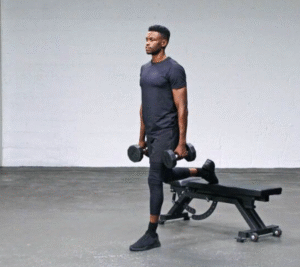
3. Dumbbell Split Squat (Static Lunge Variation)
Stand in a staggered stance: one foot forward, one foot back (rear foot on floor). Hold dumbbells at your sides. Lower your hips until your front thigh is parallel to the floor, then drive up through the front heel. Keep torso upright and core braced. This move digs deep into quad activation, especially on the front leg. TRX Training – United States
Perform 3 sets of 6–8 reps per leg. Rest ~60–75 seconds between sets.
4. Close-Stance Dumbbell Front/Side Squat Variation
Stand with feet closer than shoulder-width, hold dumbbells at shoulder height or at sides, squat down maintaining upright torso and drive through the quads as you rise. This variation accentuates the vastus lateralis (outer quad) and helps you fully engage the quad group. Iron Bull Strength – USA
Perform 2 sets of 10–12 reps. Rest 60 seconds.
Cool-down (3–5 minutes)
Finish with gentle stretching: quad stretch (standing, pulling heel to buttock), hip flexor stretch, and hamstring lengthening. This helps your IT schedule be less impacted by stiffness later on.
Scheduling Tips for IT Managers
-
Time-box your workout: aim for 25-30 minutes including warm-up, main routine and cool-down. Fits between stand-up meeting and afternoon ticket review.
-
Choose early or late: either hit this workout before the typical IT rush begins (e.g., early morning) or after wave of incident tickets subsides (later evening).
-
Use active breaks: if a major outage is resolved and you’re waiting for follow-up tasks, do a couple of warm-up movements by your desk (bodyweight squats, leg swings) so you can smoothly shift into the dumbbell work once free.
-
Pair with tech-news check: after your workout, reward yourself with 10 minutes scanning an IT-industry source like CRN or ZDNET to stay sharp and aligned with the digital landscape. Wikipedia
-
Rest smartly: lower-body workouts require recovery. If you’re sprinting through data-centre floors all week and standing for many hours, allow at least one full day of rest or light mobility work between quad sessions.
Form & Safety Notes
-
Always keep your core engaged and your spine neutral. IT managers are no strangers to fatigue—don’t let posture slip as fatigue accumulates.
-
Pay attention to knee tracking: knees should track above your middle toes, not collapse inward. Faulty knee alignment risks injury.
-
Choose dumbbell weight by form first, not ego. Since you may be tired from late shifts or alert calls, err on the side of lighter and perfect form rather than heavier and sloppy.
-
For single-leg exercises (step-ups, split squats) ensure your support surface is stable and free of clutter (no cables, no loose server-rack wheels!).
-
Mobility matters: tight hips and quads may limit your depth and performance. Add hip flexor and glute stretches to your weekly plan.
Why This Routine Works
-
It covers both bilateral (goblet squat, close-stance squat) and unilateral (step-up, split squat) movements, giving you balanced quad development.
-
Dumbbells offer flexibility and portability—ideal for a home office, hotel workout room during a site visit, or small gym.
-
The routine emphasises quad activation but supports overall leg strength, which is beneficial when combined with compound body movements.
-
The short duration makes it viable for an IT manager’s busy schedule; you’re not sacrificing hours on ‘leg day’ when a server-farm emergency might pop up.
-
Strong quads support posture, movement efficiency, metabolic health and injury prevention—helping you stay fit in a role that demands sharp mind, steady body and long hours.
Conclusion
As an IT manager you already invest heavily in your brain, your team and your tech. Now it’s time to invest in your body—particularly your quads—so you can stand taller, move more freely, recover faster and be ready when the next system outage or infrastructure sprint hits. The dedicated best workout for quads dumbbell, scheduled wisely and performed with good form, provides high-value return for time invested. Use the routine above, slot it into your calendar around your tech tasks, and watch as your legs become more resilient, your posture improves and your overall energy rises. Remember: your infrastructure protects your organisation’s data—your body protects you. Make your quads a priority. 🚀