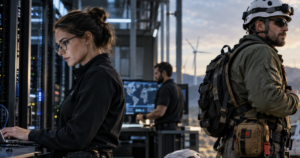
Modern information technology no longer exists only inside climate-controlled offices, server rooms, and corporate headquarters. IT professionals now work in data centers, industrial facilities, construction environments, telecommunications sites, live-event venues, transportation hubs, remote installations, utility locations, and temporary field operations. The expansion of connected infrastructure has changed what organizations expect from technical teams. Keeping networks, communications systems, servers, security equipment, and digital infrastructure operational often requires technicians to work in environments where physical safety matters just as much as cybersecurity.
That change is expanding the meaning of preparedness within the technology industry. Organizations have spent decades building sophisticated plans for cyberattacks, network outages, power failures, hardware problems, data loss, and natural disasters. Physical emergencies involving the people responsible for those systems deserve the same practical attention.
The connection becomes clearer when looking at how important technology has become to everyday life. The Cybersecurity and Infrastructure Security Agency describes the Information Technology Sector as central to national security, the economy, public health, and public safety. When technology professionals support infrastructure with that level of importance, readiness cannot stop at passwords, backups, firewalls, and redundant servers.
Modern IT Has Moved Far Beyond the Traditional Office
The popular image of an IT employee sitting behind a desk represents only a portion of today’s technology workforce. Network engineers may travel between buildings. Telecommunications technicians can work around towers and remote communication systems. Data center specialists regularly move heavy equipment and install hardware. Field engineers troubleshoot systems at customer locations. Technical crews supporting concerts, conferences, sporting events, and large productions routinely work around electrical equipment, temporary structures, loading areas, and extensive cabling.
Even conventional corporate IT departments are responsible for infrastructure spread across warehouses, manufacturing plants, offices, retail locations, distribution centers, campuses, and remote facilities.
This evolution reflects the larger transformation of information technology itself. Computing is deeply integrated into communications, logistics, commerce, manufacturing, security, entertainment, healthcare, transportation, and countless other industries. The technology workforce follows that infrastructure wherever it operates.
The result is a broader risk environment.
An employee repairing a network switch in an office has different surroundings than a technician restoring communications at a remote installation after severe weather. A systems engineer working inside a data center encounters different physical conditions than someone deploying equipment for an outdoor production. Modern preparedness programs should recognize those differences instead of treating every technical employee as an office worker.
Business Continuity Depends on People as Well as Technology
Business continuity planning traditionally emphasizes systems. Organizations maintain backups, redundant connections, emergency power systems, secondary data centers, cloud infrastructure, incident-response plans, and disaster-recovery procedures.
Those investments are essential, but infrastructure does not recover itself.
People replace damaged equipment. People diagnose connectivity problems. People restore servers. People repair communications links. People coordinate vendors. People evaluate failures and make decisions about what should be restored first.
The current NIST Cybersecurity Framework reflects a comprehensive approach to organizational cyber risk, while its concepts of identifying risk, protecting resources, detecting problems, responding to incidents, and recovering from disruption have helped shape modern resilience thinking throughout the technology industry.
Physical preparedness complements that philosophy.
A company can maintain excellent redundancy and still encounter operational problems when employees are injured, isolated, or unable to safely continue working. Resilience therefore involves more than protecting technology assets. It also means considering the conditions faced by the people responsible for maintaining those assets.
This does not mean every IT employee needs to become a medical professional. It means organizations can evaluate foreseeable hazards, provide appropriate supplies, develop procedures, and make training available based on the actual environments where employees work.
Field Technology Creates a Different Safety Environment
Field operations introduce variables that rarely exist in conventional offices.
Technical personnel may work considerable distances from normal company facilities. They may travel in vehicles carrying valuable equipment. They can spend time at customer sites where they have limited familiarity with the property. Some locations may have restricted access, industrial machinery, electrical systems, ladders, construction activity, moving equipment, or weather exposure.
Telecommunications and infrastructure teams may operate in even more demanding environments. Emergency restoration work can take place following storms, floods, power failures, or other disruptions.
The growing importance of infrastructure resilience has received significant attention from CISA’s resilience programs, which emphasize preparation, adaptation, continuity, and recovery when critical systems face disruptive events.
For IT organizations, that broader resilience mindset can be translated into practical operational planning.
Emergency contact procedures should be established before crews arrive at remote sites. Employees should understand how to identify their location when contacting emergency services. Vehicles should carry appropriate safety supplies. Field teams should know how to communicate when primary cellular or network services are unavailable. Managers should consider travel conditions, environmental hazards, and the availability of nearby emergency services.
A medical kit becomes one element within that larger preparedness strategy rather than a substitute for professional emergency response.
The Convergence of IT, Operations, and Physical Infrastructure
One of the most important trends in modern technology is the disappearance of the old boundary between information technology and operational technology.
Networks increasingly connect cameras, access-control systems, industrial equipment, environmental controls, sensors, building systems, manufacturing technology, communications hardware, and Internet of Things devices. As those systems become connected, IT professionals become more involved with the physical environments in which they operate.
That creates a new type of technology workplace.
A network specialist may need access to a mechanical area because networked building equipment is installed there. A security systems technician may work throughout a large property rather than inside one office. An audiovisual technician may spend an entire day around stages, rigging areas, cables, loading docks, and electrical equipment. A telecommunications engineer may travel to isolated infrastructure sites.
Companies therefore have practical reasons to integrate IT operations into their broader workplace safety programs.
The Occupational Safety and Health Administration notes that workplace medical and first-aid programs should reflect the circumstances and hazards associated with individual workplaces. That principle is especially relevant when a company’s technology personnel operate in several very different environments.
Emergency Preparedness Is Becoming Part of Technology Risk Management
Risk management is fundamentally about identifying realistic problems before they become emergencies.
IT departments already apply this thinking constantly.
They monitor system health because failures are easier to address when detected early. They install backup power because electrical outages are predictable risks. They maintain redundant network connections because communications failures happen. They keep spare equipment because hardware eventually fails. They establish incident-response procedures because confusion during a crisis increases downtime.
Physical emergency preparedness follows similar logic.
Organizations cannot predict every workplace incident, but they can prepare for reasonable possibilities.
Companies with remote employees, mobile field teams, technology installers, infrastructure crews, event technicians, warehouse technology personnel, and data center workers have particularly strong reasons to examine emergency readiness.
The objective is not to assume that disaster is imminent. The objective is to reduce unnecessary vulnerability when something unexpected occurs.
Training Matters as Much as Equipment
Possessing emergency equipment and knowing how to use it are two different things.
A well-stocked medical kit has limited value if nobody present understands basic first-aid principles or the company’s emergency procedures. Organizations developing serious preparedness programs should therefore consider training alongside equipment.
The American Red Cross workplace safety program provides First Aid, CPR, AED, and other emergency-response training for businesses and employees. Training can help employees recognize emergencies, contact professional responders, provide appropriate assistance within the scope of their instruction, and avoid actions that could make a situation worse.
That distinction is important.
Emergency medical supplies do not turn a person into a trained medical provider, and equipment should never be viewed as a replacement for emergency medical services. Appropriate instruction helps workers understand both what they can do and when professional medical intervention is necessary.
Technology companies can approach readiness in the same structured way they approach technical certification. Equipment, procedures, knowledge, and practice work together.
Remote Work Has Created New Forms of Field Work
Remote work is usually associated with laptops and home offices, but distributed technology operations have also increased the number of employees working away from centralized company facilities.
IT consultants regularly visit client locations. Managed service providers dispatch technicians across large geographic areas. Network installers travel between job sites. Cybersecurity professionals sometimes perform assessments at industrial or infrastructure facilities. Hardware teams install systems at newly opened locations. Communications specialists support temporary operations and mobile command environments.
Organizations should know where employees are operating and what assistance is available nearby.
Emergency preparation becomes particularly important when crews work at locations where response times may be longer than they would be in major business districts. A technician working at an isolated communications facility cannot assume the same immediate access to assistance available inside a downtown office tower.
Preparedness planning can account for distance, communications reliability, transportation, weather, local emergency services, site access, and the hazards associated with the specific assignment.
Data Centers Present Their Own Operational Considerations
Data centers may appear highly controlled, but they remain physical workplaces filled with electrical systems, heavy equipment, battery systems, cooling infrastructure, raised floors, cables, racks, tools, loading operations, and equipment movement.
They also operate continuously.
Maintenance and emergency repair activities may take place outside normal business hours when fewer employees are present. That makes internal procedures and accessible emergency supplies particularly important.
IT leaders planning data center resilience often concentrate on uptime measurements, power redundancy, network architecture, cooling, security, backup systems, and hardware availability. Human safety deserves a place in that same conversation.
A resilient facility protects both its technology and the people who keep that technology operational.
Live Events Show How Closely Technology and Physical Operations Have Merged
Few environments demonstrate the convergence of IT and field operations more clearly than modern live events.
Concerts, conventions, sporting events, corporate productions, festivals, and large gatherings rely heavily on digital technology. Network infrastructure supports ticketing, communications, point-of-sale systems, streaming, production systems, security, lighting controls, video, audio, and backstage operations.
Technical crews often work around temporary power distribution, heavy cases, extensive cabling, stages, loading docks, vehicles, and rapidly changing workspaces.
Technology failure can disrupt an event, but physical incidents can disrupt operations just as quickly.
For companies serving this industry, technology preparedness and workplace preparedness increasingly belong within the same operational strategy.
Preparedness Also Supports Disaster Recovery
Disaster recovery has historically been one of IT’s most important responsibilities. Hurricanes, tornadoes, floods, wildfires, winter storms, and other events can damage infrastructure and create widespread communications problems.
Technology crews are often involved early in recovery.
They may restore Internet connectivity, replace networking hardware, establish temporary communications, recover data systems, deploy mobile technology, reconnect facilities, or support employees returning to damaged locations.
Federal preparedness resources such as Ready.gov for businesses encourage organizations to plan for emergencies before they happen and to consider continuity, communications, employees, facilities, and recovery.
That planning is particularly relevant to IT departments because technology is involved in nearly every part of modern business recovery.
When organizations develop emergency response and disaster recovery procedures, the safety and preparedness of technical teams should be included from the beginning rather than addressed after an incident occurs.
Modern IT Leadership Requires a Broader Definition of Resilience
The IT department has become one of the most important operational functions in many organizations.
Modern businesses rely on technology for communications, transactions, security, customer relationships, logistics, finance, production, collaboration, and basic daily operations. That responsibility has pushed technology leaders beyond traditional hardware and software management.
Today’s IT leaders increasingly participate in cybersecurity, compliance, business continuity, disaster recovery, physical security, vendor management, risk management, and infrastructure planning.
Workplace preparedness fits naturally within that evolution.
A mature technology operation considers what happens when systems fail, communications disappear, facilities become inaccessible, employees are injured, weather disrupts transportation, or crews must operate temporarily under difficult conditions.
Preparedness does not require dramatic assumptions. It requires identifying realistic risks and addressing them before an emergency exposes weaknesses.
Building a More Complete Preparedness Strategy
Organizations reviewing field readiness should consider the entire emergency-response chain.
Communication comes first. Employees should know whom to contact internally and how to reach emergency services.
Location awareness is equally important. Mobile technicians should be able to accurately communicate where they are working.
Training should match the working environment and responsibilities of the employee.
Emergency supplies such as GP IFAK Level 2 should be appropriate for the workplace and periodically inspected so expired, damaged, or missing items can be replaced.
Procedures should also account for the possibility that normal technology may not be available. A severe storm, widespread power outage, communications failure, or damaged network can remove many of the digital tools employees normally depend upon.
These measures create layers of resilience.
The concept is familiar to anyone working in cybersecurity. Organizations rarely trust a single security control to protect an entire network. They create overlapping safeguards so the failure of one system does not automatically result in complete failure.
Emergency preparedness benefits from the same layered approach.
The Future of IT Readiness Is Both Digital and Physical
Technology will continue moving deeper into the physical world.
Artificial intelligence, edge computing, private wireless networks, smart buildings, robotics, connected transportation, industrial automation, distributed sensors, cloud infrastructure, and Internet of Things devices are expanding the environments that technology professionals must support.
That means tomorrow’s IT professional may be as likely to work in a warehouse, stadium, manufacturing facility, remote communications site, transportation center, or temporary field location as in a traditional office.
The definition of IT preparedness must evolve with that reality.
Cybersecurity remains critical. Business continuity remains critical. Data protection remains critical. Infrastructure redundancy remains critical. Yet organizations also depend on the people who install, maintain, protect, and recover those systems.
Providing those employees with thoughtful emergency planning, appropriate supplies, reliable communications, training, and clearly defined procedures creates a stronger operational foundation.
Conclusion
Modern IT has become inseparable from the physical infrastructure that keeps businesses and communities operating. Technical professionals now work across data centers, remote installations, production environments, telecommunications facilities, customer locations, large events, warehouses, industrial properties, and critical infrastructure sites.
As the technology workforce becomes more mobile and operationally diverse, emergency preparedness becomes a practical component of IT resilience.
Companies already understand the value of redundancy, backup systems, incident planning, and disaster recovery. Extending that preparedness philosophy to the people maintaining those systems is a logical progression.
The strongest technology organizations will continue protecting networks and data while also recognizing the realities of the environments where their employees work. Digital resilience and physical readiness are no longer separate ideas. Together, they form a more complete approach to keeping modern technology operations running when circumstances become unpredictable.